
Many students hit a wall in middle or high school math, and parents often feel stuck watching grades slip while standardized test deadlines creep closer. A well-designed school math tutoring program can change that trajectory, but only if it's built on evidence rather than guesswork. High-dosage math tutoring yields significant gains in student learning, yet most programs never reach that threshold. This guide walks you through every step, from understanding what the research actually says to recruiting tutors, structuring sessions, and keeping families engaged for the long haul.
Table of Contents
- Understanding what makes math tutoring effective
- Assessing needs and designing your program
- Recruiting and training qualified tutors
- Building effective sessions and measuring impact
- Engaging families and sustaining attendance
- Our take: the biggest mistake parents make when choosing a tutoring program
- Ready to build a program that actually moves the needle?
- Frequently asked questions
Key Takeaways
| Point | Details |
|---|---|
| High-dosage is critical | Three or more math sessions per week produce the strongest gains for students. |
| Qualified tutors matter most | Certified teachers or trained paraprofessionals consistently yield better results in math tutoring. |
| Family engagement boosts attendance | Weekly updates and strong communication with parents drive higher participation rates. |
| Align to classroom learning | Programs matched to school curriculum outperform generic homework help schemes. |
| Start focused, scale with care | Launching small and maintaining quality is more effective than expanding rapidly without oversight. |
Understanding what makes math tutoring effective
Not all tutoring is created equal. A student sitting with a tutor once a week for 30 minutes while watching YouTube in between sessions is not going to close a two-year learning gap. The research is clear, and the bar is higher than most parents expect.
Studies show that high-dosage tutoring produces 0.13 to 0.37 SD gains, which translates to roughly three to six months of additional learning. That's meaningful progress, especially in math, where gains tend to be stronger than in reading at the secondary level. To hit those numbers, you need intensity and consistency, not occasional drop-in sessions.
What does "high-dosage" actually mean in practice? According to tutoring research standards, it means three or more sessions per week, each lasting 30 to 60 minutes, for a total of at least 90 minutes per week. The curriculum must align directly to what students are learning in their math classes, and tutors should use assessments to personalize plans and track progress over time.
What the data shows
| Program type | Frequency | Expected gain |
|---|---|---|
| Low-dosage (1x/week) | Under 60 min/week | Minimal to none |
| Moderate (2x/week) | 60 to 90 min/week | 0.05 to 0.10 SD |
| High-dosage (3x+/week) | 90+ min/week | 0.13 to 0.37 SD |
The table above makes the point bluntly. Frequency and total minutes per week drive outcomes. A program that looks good on paper but only delivers one session per week will not move the needle for most students.
Here are the most common pitfalls that sink otherwise well-intentioned programs:
- Low attendance rates that prevent students from reaching the dosage threshold
- Curriculum misalignment, where tutoring content has nothing to do with what's being taught in class
- No progress tracking, so tutors keep repeating material students already understand
- Inconsistent tutors who cancel frequently or lack subject matter depth
If you're thinking about math course selection for your student alongside a tutoring program, alignment between those two decisions matters more than most parents realize.
Assessing needs and designing your program
Now that you know what works, it's time to figure out exactly what your community needs and which approach will best meet those needs. Skipping this step is one of the most expensive mistakes a program organizer can make.
Start by conducting market research on local needs, identifying gaps such as underserved math levels, missing test prep support, or students who fall between school-based interventions and private tutoring. Talk to teachers, counselors, and parents before designing anything. Ask which grade levels are struggling most, whether the gap is in foundational skills or advanced coursework, and whether students have access to any existing support.

Once you have that picture, choose your program model. Research on effective tutoring models consistently shows that one-on-one and small group formats (two to four students) produce the strongest outcomes, with in-school sessions during the school day performing slightly better than afterschool programs because attendance is easier to control.
Comparing program models
| Model | Pros | Cons |
|---|---|---|
| One-on-one | Fully personalized, fastest gains | Most expensive, hardest to scale |
| Small group (2 to 4) | Cost-effective, peer learning benefits | Requires grouping by skill level |
| Hybrid/virtual | Flexible, lower overhead | Requires tech access and tutor training |
| Afterschool | Easier to schedule | Lower attendance, competing activities |
One surprising finding: there's no significant difference between 2:1 and 3:1 student-to-tutor ratios in terms of learning outcomes. That means you can serve three students at once without sacrificing effectiveness, which has real budget implications.
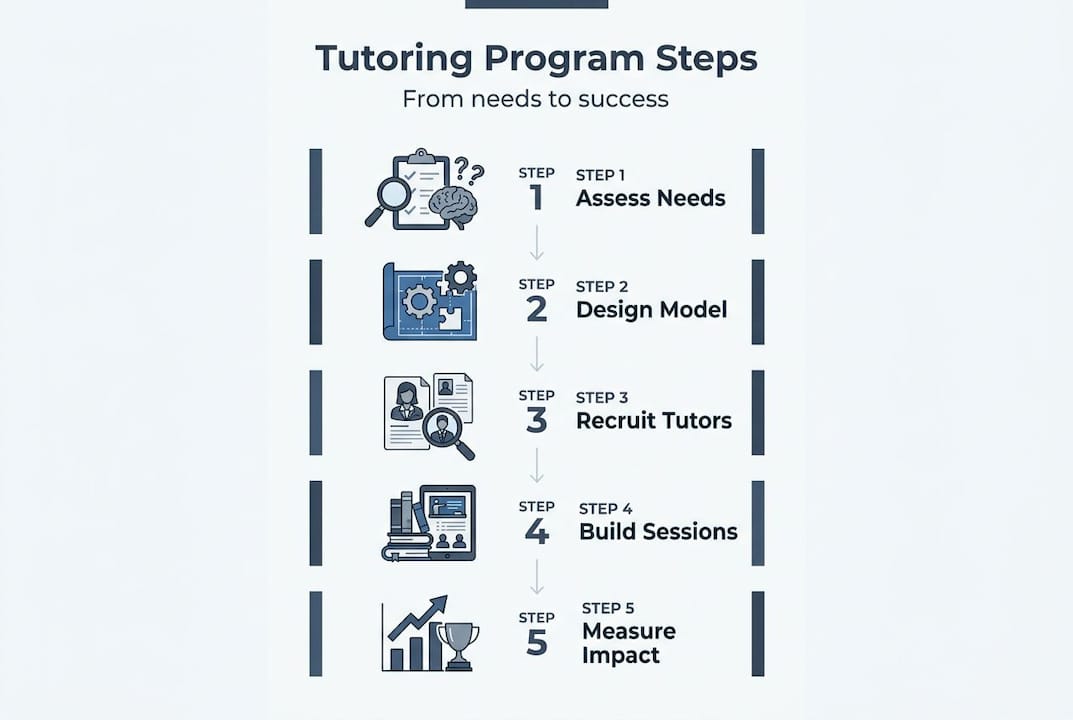
Here's a step-by-step approach to designing your program from scratch:
- Survey teachers and parents to identify the top three math skill gaps in your school or community.
- Choose a grade band to start with (for example, grades 7 and 8 only) rather than trying to serve everyone at once.
- Decide on your primary format: in-school small groups, afterschool one-on-one, or virtual sessions.
- Draft a simple operating plan that covers scheduling, session length, and how you'll track attendance.
- Set a realistic budget that accounts for tutor pay, materials, and any technology costs.
- Pilot with a small cohort before scaling, so you can catch problems early.
Pro Tip: Start with a narrow focus, such as one grade level and one math course, and scale only after you've proven the model works. Programs that try to serve every student from day one almost always struggle with consistency and quality.
If you're unsure where to begin, scheduling a free tutoring consultation with an experienced math educator can help you map out a realistic plan before committing resources.
Recruiting and training qualified tutors
With your program framework clear, the next priority is putting the right people in place and ensuring quality from day one. The tutor is the single most important variable in whether your program works.
The best sources for qualified math tutors are certified teachers (including retired or part-time teachers), trained paraprofessionals who already work in schools, and advanced college students majoring in mathematics or education. Each source has trade-offs. Teachers bring the most instructional expertise but are often stretched thin. College students are more available and affordable but need more structured training and oversight.
Pay matters more than many program organizers expect. Quality tutors typically earn $30 to $60 per hour, and training should cover explicit math instruction techniques, the Concrete-Representational-Abstract (CRA) framework, and data-driven grouping strategies. Underpaying tutors leads to high turnover, which destroys program continuity and student trust.
Training should cover these core areas before tutors ever sit down with a student:
- Explicit instruction techniques: modeling problems step by step, thinking aloud, and checking for understanding at each stage
- The CRA framework: moving students from physical manipulatives (concrete) to diagrams (representational) to symbols (abstract) as they build understanding
- Error analysis: identifying why a student made a mistake, not just marking it wrong
- Progress monitoring: using brief weekly assessments to adjust instruction rather than following a fixed script
- Growth mindset language: how to respond when students say "I'm just bad at math" in ways that redirect rather than dismiss
Whether you're organizing in-person and online tutoring or a hybrid model, the training framework should be consistent across all formats. A tutor who works online needs the same instructional skills as one sitting across the table.
Pro Tip: Schedule a 15-minute check-in with each tutor every two weeks. Ask one question: "What's one thing a student is stuck on that you're not sure how to address?" That single question surfaces training gaps before they become student outcomes.
Building effective sessions and measuring impact
With tutors in place, focus turns to what truly happens during tutoring: how sessions are structured and what gets measured. A great tutor with a weak session structure will still underperform.
The gold standard session format for math tutoring follows a clear sequence. Research on math intervention strategies recommends starting with a short warm-up that uses retrieval practice (asking students to recall prior knowledge), moving into explicit modeling using the "I do, we do, you do" structure, then guided practice with immediate feedback, and closing with an exit ticket that tells the tutor exactly what to revisit next session.
Here's how to structure a 45-minute session:
- Warm-up (5 minutes): Two or three retrieval questions from the previous session. No new material yet.
- Explicit modeling (10 minutes): Tutor works through one or two problems aloud, narrating every step.
- Guided practice (20 minutes): Student works problems with tutor support that gradually fades as confidence builds.
- Independent practice (7 minutes): Student solves one or two problems alone while tutor observes without helping.
- Exit ticket (3 minutes): One problem the student completes independently. Tutor reviews it before the student leaves.
"Connecting math to real-life situations and building a growth mindset during sessions are not soft extras. They are core to whether students return and whether they try when things get hard." — Evidence-based math intervention practice
Aligning tutoring content to curriculum alignment strategies used in school is non-negotiable. A student learning polynomial operations in class should be practicing polynomial operations in tutoring, not working on unrelated review material. Tutors should request a copy of the classroom pacing guide at the start of each semester.
For test prep, test prep timelines should be built into the program calendar from the start, especially for students targeting the SAT or ACT. Integrating test-style problems into regular sessions, rather than treating test prep as a separate activity, produces better results and saves time.
Implementing high-dosage tutoring also requires weekly progress checks. These don't need to be formal tests. A five-question quiz at the end of each week, scored and logged, gives you enough data to spot when a student is plateauing and when to adjust the approach.
Engaging families and sustaining attendance
Beyond math expertise, ensuring families remain engaged and students actually show up is what separates programs that last from those that quietly disappear after one semester.
Strong family communication predicts sustained participation better than almost any other factor. Programs that send weekly text or email updates to parents, share specific progress data rather than vague encouragement, and flag attendance issues early consistently hit the 75% or higher attendance rates needed for high-dosage impact.
Practical family engagement tactics that actually work:
- Weekly progress texts: One sentence describing what the student worked on and one win from the session. Parents read these. They share them with students.
- Monthly data summaries: A simple chart showing quiz scores over time. Visible progress is motivating for both students and parents.
- Clear cancellation policies: Require 24-hour notice for cancellations and limit them to two per month before a student is moved to a waitlist spot.
- Student goal-setting: At the start of each month, have students write one specific math goal. Share it with parents. Revisit it at month's end.
- Parent-tutor communication tips are available through the client resources at mathtutorct.com, which can help you build a communication template that saves time while keeping families in the loop.
Attendance policies are where many programs go soft. Avoid the temptation to excuse every absence to keep families happy. Students who miss more than 25% of sessions rarely reach the learning gains the program promises. Set the expectation early, enforce it consistently, and offer make-up options when possible rather than simply waiving the requirement.
Our take: the biggest mistake parents make when choosing a tutoring program
After working with students in grades 7 through 12 since 2004, the pattern is clear: parents often choose a tutoring program based on convenience rather than structure. A tutor who is available on short notice, affordable, and friendly is appealing. But if that tutor doesn't follow a session structure, doesn't align to the classroom curriculum, and doesn't track progress, the student will feel better about math without actually getting better at it.
The uncomfortable truth is that feeling supported and making measurable gains are not the same thing. A well-run program will sometimes feel harder than a loosely run one because it holds students accountable through exit tickets, weekly quizzes, and attendance requirements. That friction is not a flaw. It's the mechanism.
Parents who push back on structure, who want tutoring to be purely encouraging without any assessment, are often the ones who call six months later wondering why nothing has changed. The research on high-dosage tutoring is not subtle. Intensity, alignment, and measurement are what produce results. Everything else is supplementary.
Ready to build a program that actually moves the needle?
Starting a math tutoring program that produces real results takes more than good intentions. It takes a structured approach, qualified tutors, aligned curriculum, and consistent family engagement. If you're a parent trying to figure out the right path for your middle or high schooler, or a school administrator looking to build something sustainable, the principles in this guide apply directly.

At mathtutorct.com, Richard Corn has been helping students in grades 7 through 12 build real math skills since 2004, with published test prep books that have reached over 50,000 students. Whether your student needs support in Pre-Algebra, Calculus, or SAT/ACT prep, the individualized approach here is built on exactly the evidence-based practices outlined above. Reach out to schedule a consultation and find out which program structure fits your student's specific needs and timeline.
Frequently asked questions
How much does it cost to start a school math tutoring program?
Costs typically range from $1,200 to $5,000 per student per year, with university-led programs running higher and virtual or afterschool models coming in at the lower end.
How many students should be in each math tutoring group?
Optimal group size is two to four students, and research shows no meaningful difference in outcomes between 2:1 and 3:1 student-to-tutor ratios.
Are online and in-person math tutoring equally effective?
Yes. Virtual tutoring is as effective as in-person when programs maintain instructional fidelity, use interactive tools, and hold students to the same attendance standards.
How often should students participate in tutoring for the best results?
Three or more sessions per week, totaling at least 90 minutes, are the threshold for high-dosage impact and measurable learning gains.
What's the most common reason school math tutoring programs fail?
Effects can drop by half at scale due to fidelity loss, making rapid expansion without quality controls the most common reason programs stop producing results.